This project provides a comprehensive analytical review of the Karlsruhe Tritium Neutrino (KATRIN) experiment, exploring its theoretical underpinnings, complex instrumentation, and latest empirical findings. Conducted as a term paper for the "Detector & Accelerator Technology" course at NTUA, the report examines the technical challenges of measuring the absolute mass scale of neutrinos using model-independent kinematics.
The theoretical analysis and hardware evaluation developed in this study cover:
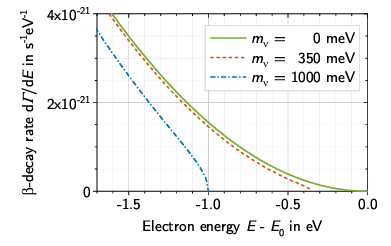
- Neutrino Kinematics & $\beta$-Decay: Mathematical formulation of neutrino flavor oscillations (PMNS matrix) and the precise modeling of molecular tritium ($\mathrm{T_2}$) $\beta$-decay. The analysis focuses on the differential decay rate near the 18.6 keV endpoint energy, incorporating complex theoretical corrections (e.g., final-state distributions, radiative corrections).
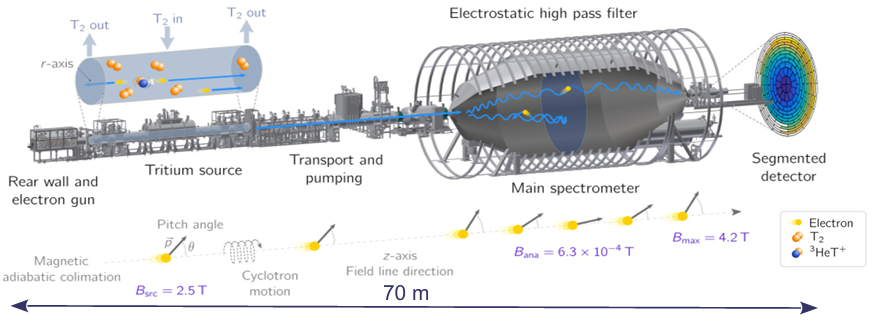
- Source & Transport Infrastructure: Evaluation of the Windowless Gaseous Tritium Source (WGTS) operating at 30 K via two-phase Neon cooling to maintain strict column density stability. Analysis of the $10^{14}$ tritium flow reduction achieved by the Differential Pumping Section (DPS chicane) and Cryogenic Pumping Section (CPS Argon frost).
- MAC-E Filter Spectrometry: Operational principles of Magnetic Adiabatic Collimation combined with an Electrostatic filter. The report details how this configuration acts as a high-pass integrating energy filter, achieving an unprecedented energy resolution of $\Delta E \approx 0.93$ eV.
- Background Reduction & Detection: Investigation into the mitigation of Penning traps and Rydberg atom ionizations using inner wire electrodes and a Shifted Analyzing Plane (SAP). Electrons are ultimately counted using a segmented 148-pixel silicon p-i-n diode Focal Plane Detector (FPD).
- Data Analysis & Results: Review of the statistical convolution of the experimental response function with the theoretical $\beta$-spectrum. The combined data from the KNM1 through KNM5 campaigns resulted in a world-leading upper limit for the effective neutrino mass of $m_\nu <$ 0.45 eV (90% C.L.).
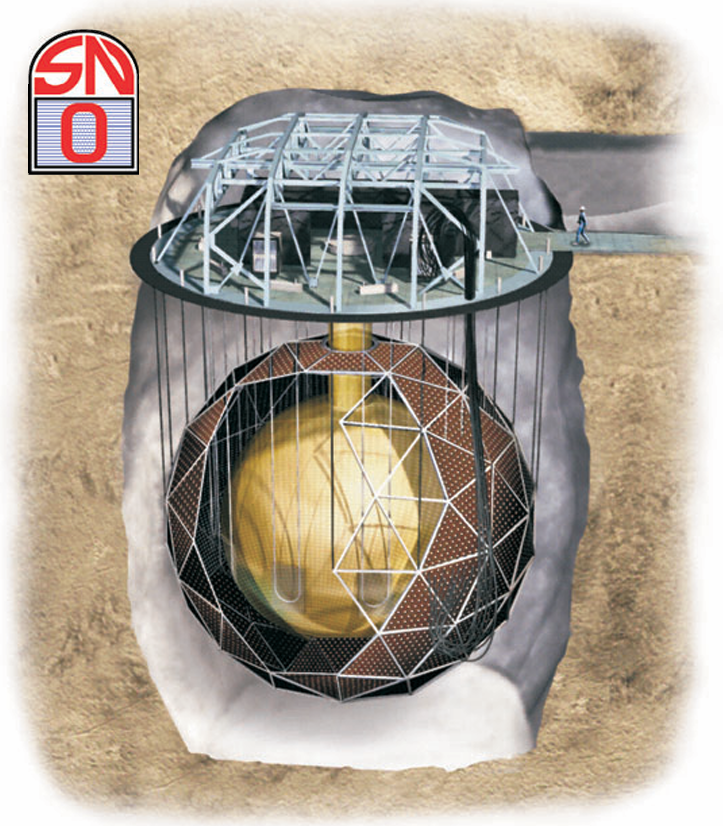
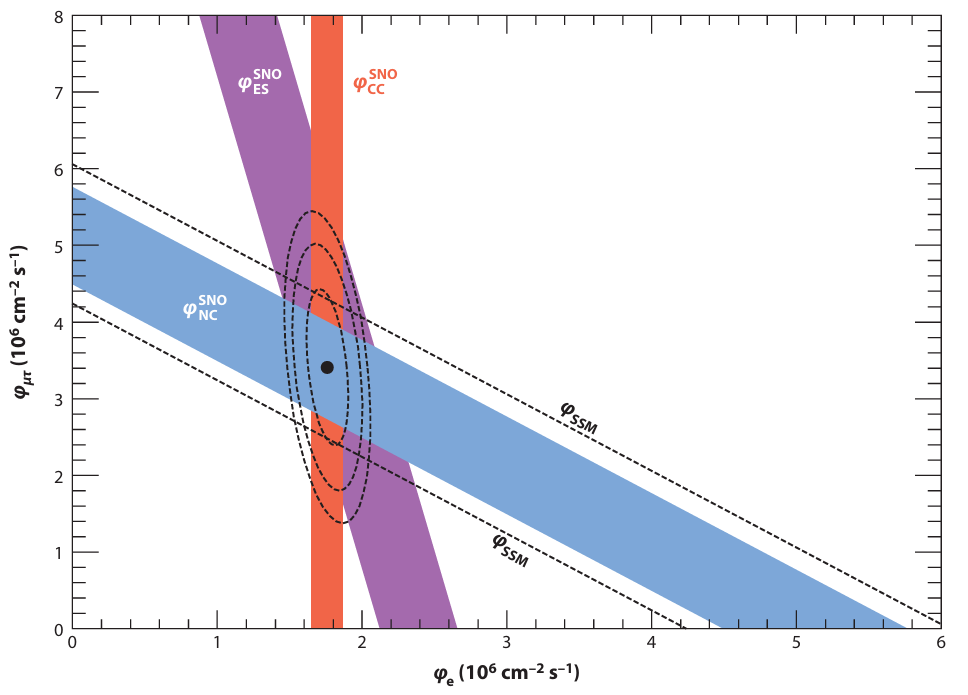
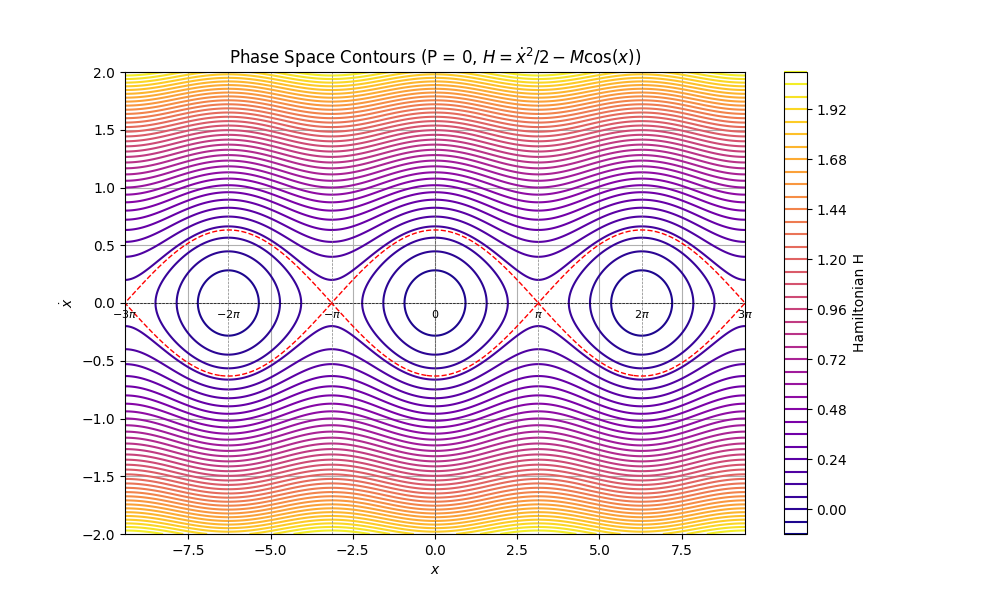
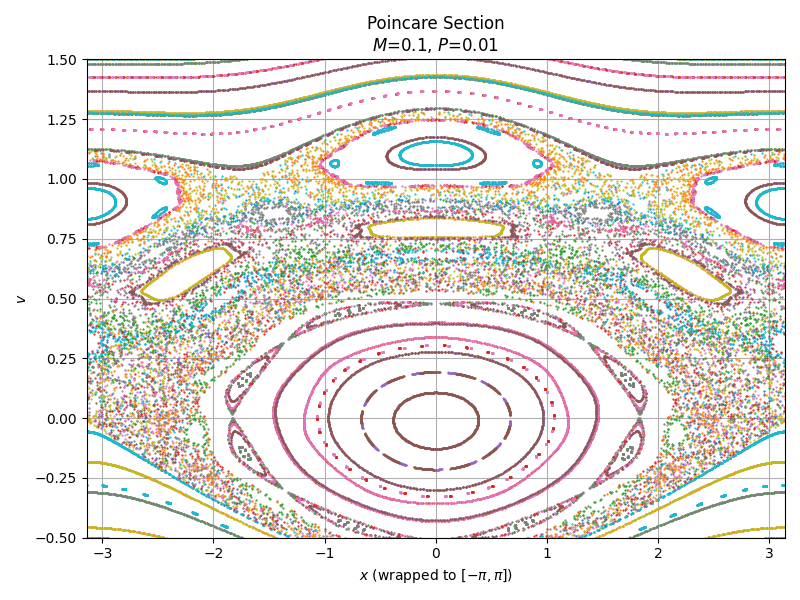
Below are visual representations highlighting the experimental setup and the theoretical modulation of the tritium $\beta$-decay spectrum:
The complete academic review and the accompanying presentation slides are available below.
Note: The detailed report and presentation are written in Greek, though the embedded mathematics, schematics, and data plots follow universal scientific notation.